
We’ve all heard the classic nutritional advice: “Eat your eggs, they’re good for you.” But if you really press someone on why, the answer usually stops at “well, they have a lot of protein.”
While that’s definitely true, it barely scratches the surface of what makes the humble egg a literal marvel of nature.
Here is the mind-blowing fact that elevates the egg from a simple breakfast staple to a biological masterpiece: Eggs contain all 9 essential amino acids in the exact proportions your body needs.
Let’s crack open the science behind why this matters, what “essential amino acids” actually are, and why the egg reigns supreme as nature’s perfect protein.
The Protein Puzzle: What Are Amino Acids?
To understand why eggs are so special, we have to look at how protein works. Think of protein as a complex, custom-built brick house. Amino acids are the individual bricks.
When you eat protein, your body doesn’t just absorb it whole. It breaks that protein down into individual amino acids, shuffles them around, and rebuilds them into new proteins to repair muscles, create hormones, boost immunity, and keep your hair and skin glowing.
In total, there are 20 amino acids that your body needs to function. They are divided into two main categories:
- Non-Essential Amino Acids (11 of them): Your body is a bit of a magician here—it can manufacture these on its own, even if you don’t get them from food.
- Essential Amino Acids (9 of them): Your body cannot make these. If you don’t get them from your diet, your body simply goes without.
The “9 Essential” Lineup
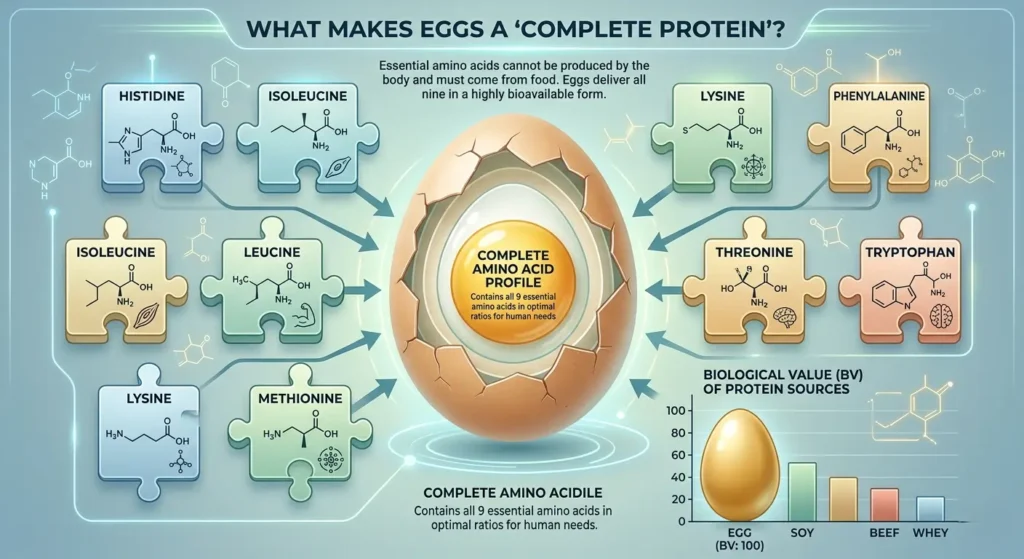
The nine VIP amino acids you must eat are: Histidine, Isoleucine, Leucine, Lysine, Methionine, Phenylalanine, Threonine, Tryptophan, and Valine.
If your diet is missing even one of these, your body’s ability to repair itself and function optimally starts to stall.
What Makes Eggs a “Complete Protein”?
In the nutritional world, proteins are graded as either “complete” or “incomplete.”
- Incomplete proteins (mostly found in plant sources like beans, nuts, and grains) contain some essential amino acids but are low or lacking in others. To get all nine, you have to pair them up (like eating rice and beans together).
- Complete proteins contain all 9 essential amino acids in adequate amounts.
Eggs aren’t just a complete protein; they are the gold standard of complete proteins.
Scientists and nutritionists use a measure called the Biological Value (BV) to score how efficiently your body can utilize the protein you eat. For decades, the whole egg was given a Biological Value score of 100—the benchmark against which all other foods were measured.
When you eat an egg, your body recognizes the exact ratio of amino acids and absorbs them with near-perfect efficiency. It’s like a lock and key.
Busting the Myth: Whole Egg vs. Egg Whites
For years, fitness trends told us to ditch the yolk and eat only the whites. If you’re looking purely at the amino acid profile, that’s a mistake.
While the egg white contains more than half of the total protein content, the yolk contains the rest of it. Furthermore, the yolk is where the magic happens. It holds the healthy fats and fat-soluble vitamins (like Vitamins A, D, E, and K) that your body actually requires to absorb and utilize those amino acids effectively.
If you throw away the yolk, you are throwing away a massive chunk of the egg’s muscle-building, health-boosting potential.
Beyond Amino Acids: The Other Hidden Perks of Eggs
The 9 essential amino acids are the stars of the show, but eggs come with an incredible supporting cast of nutrients:
- Choline: Essential for brain development, memory, and nervous system health. One large egg provides about 25% of your daily requirement.
- Lutein and Zeaxanthin: Powerful antioxidants found in the yolk that protect your eyes from macular degeneration and cataracts.
- Vitamin D: One of the few natural food sources of this crucial bone- and immune-supporting vitamin.
- Satiety: Because of the perfect balance of protein and healthy fats, eggs keep you feeling full for longer, making them a secret weapon for weight management.
How to Get the Most Out of Your Eggs
To maximize the nutritional punch of those 9 essential amino acids, how you prepare your eggs matters.

- Cook them: Raw egg protein is only about 50% bioavailable to the body. Cooking the egg denatures the protein, making it much easier for your digestive system to break down and absorb (up to 91% bioavailability!).
- Don’t overcook the yolks: While you want the whites firm, keeping the yolks slightly soft (like poach or soft-boiled) prevents the delicate antioxidants and healthy fats from oxidizing.
- Pair with veggies: Combine your eggs with spinach, peppers, or avocado to create a synergy of nutrients that boosts absorption even further.
The Verdict: Nature’s Original Superfood
In a world full of expensive protein powders, synthetic supplements, and trendy superfood powders, the humble egg reminds us that nature usually gets it right the first time.
It is affordable, incredibly versatile, and packed to the brim with every single foundational block your body needs to thrive. So, the next time you crack open an egg for breakfast, remember: you aren’t just making a meal. You’re fueling your body with a perfectly engineered biological masterpiece.